Markets - 6 min read
Stock Market Today: Nasdaq Drops on AI Capex Fears as Dow Gains
Stock market today: Tech stocks drag the Nasdaq and S&P 500 lower over AI spending fears, while the Dow Jones rallies on cyclical strength and falling oil.
FinStackX Editorial Team ·
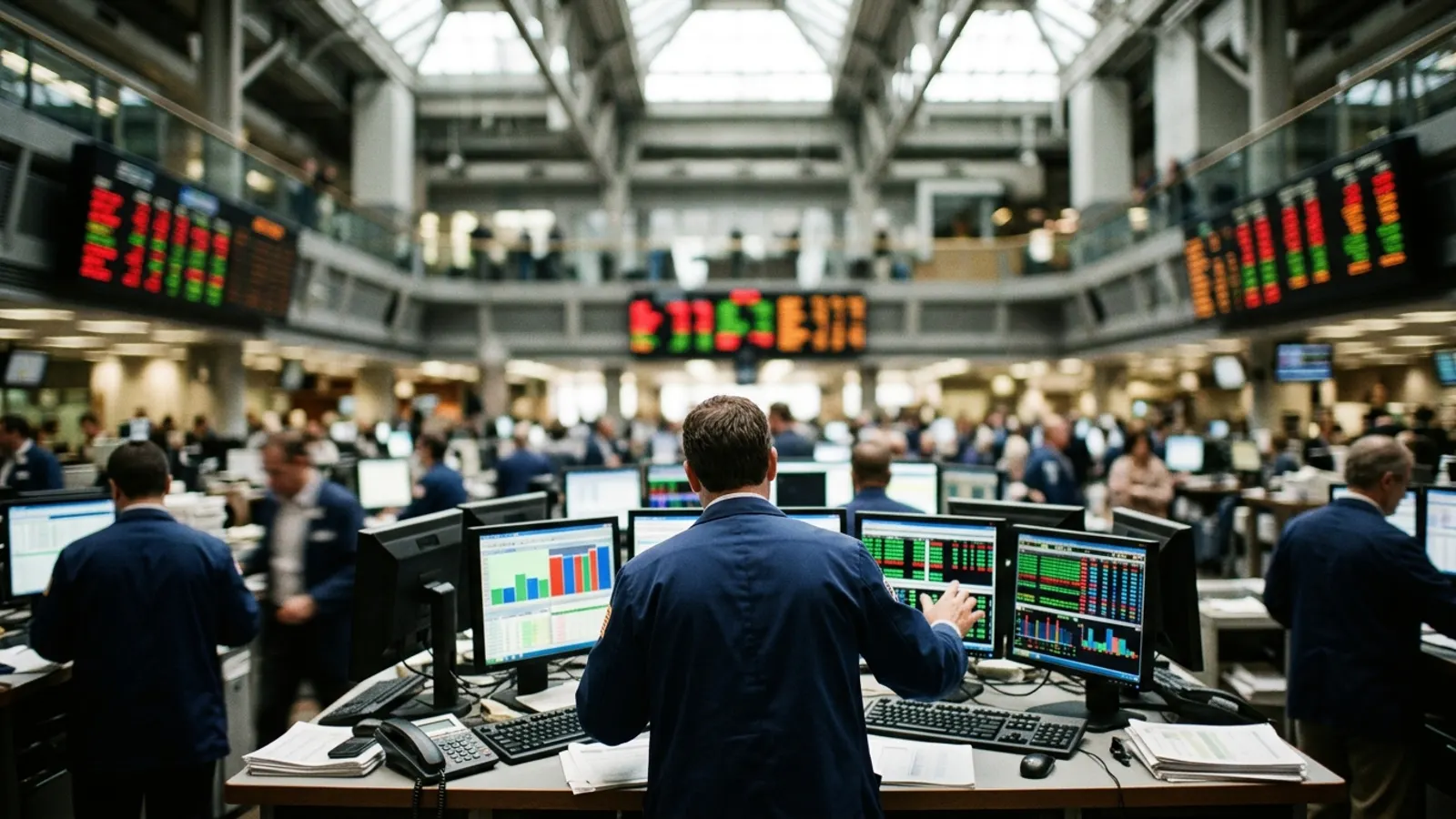
In the stock market today, U.S. equities experienced a sharp divergence on Monday, November 2, 2026, as mounting concerns over artificial intelligence (AI) infrastructure costs dragged the tech-heavy Nasdaq Composite down 1.07%, while the Dow Jones Industrial Average rallied 0.41% on cyclical strength. Investors rotated out of semiconductor and mega-cap tech stocks and into industrial names, aided by a nearly 8% plunge in crude oil prices on hopes of easing Middle East tensions.
Key takeaways
- The Nasdaq Composite fell 1.07%, while the Dow Jones Industrial Average gained 0.41%.
- Tech stocks slumped on massive AI capital expenditure (capex) commitments from companies like Oracle and Anthropic.
- Oil prices plunged over 7.5% on renewed hopes for U.S.-Iran diplomacy.
- Analysts are eyeing the November 3 U.S. midterm elections as the next major volatility catalyst.
What happened in the stock market today
Trading on Monday saw a stark split between technology and traditional industrial sectors. Total composite volume across U.S. exchanges reached 18.8 billion shares, exceeding the 20-day moving average of 17.3 billion shares, according to Reuters.
| Index | Final Close | Point Change | Percentage Change |
|---|---|---|---|
| Dow Jones Industrial Average | 51,983.98 | +213.67 | +0.41% |
| S&P 500 | 7,541.40 | -38.67 | -0.51% |
| Nasdaq Composite | 25,164.32 | -272.68 | -1.07% |
| Russell 2000 | 2,805.88 | -5.97 | -0.21% |
| Nasdaq-100 | 27,989.85 | -395.03 | -0.39% |
Note: Financial data providers showed slight discrepancies in final prints. While AP and StreetSignal reported the S&P 500 at 7,541.40, preliminary figures from Newsmax cited 7,542.27, and Fio banka reported 7,541.37. Similarly, the Dow's official close was 51,983.98, though some preliminary feeds logged 51,992.19.
The Nasdaq initially gained up to +1.4% in morning trading before afternoon selling pressure erased those gains, as noted by BigGo Finance. The S&P 500 followed a similar trajectory, trading up as much as +1.1% early on before reversing, according to StreetSignal.
Why it matters
The primary driver of Monday's market action was a clash between "capex" (capital expenditure—money spent on physical assets like data centers) strain in the tech sector and a rotation into cyclical stocks (companies whose performance is tied to the broader economy).
AI Financing Concerns Weigh on Tech Investors balked at the sheer scale of spending required to build AI infrastructure. Oracle (ORCL) shares dropped between 8.85% and 9.3% after regulatory filings revealed plans to raise $20 billion—split evenly between common equity and corporate bonds—for AI data centers, according to BigGo Finance and StreetSignal.
In the semiconductor space, Marvell Technology (MRVL) fell roughly 12.7% after agreeing to acquire optical supplier Lumentum in a $115 billion all-stock deal. Lumentum plunged between 18.6% and 19.0% due to deal arbitrage spreads (the price difference traders exploit during acquisitions) and shareholder dilution, per Fio banka. Adding to the sector's woes, Intel (INTC) fell another 8.7% to 9.3%, compounding a 28.6% drop from the previous Friday driven by weak guidance and projected negative cash flow, according to AP. The Philadelphia Semiconductor Index has now slid 11% over three days, reported Bloomberg.
Meanwhile, an S-1 amendment from AI startup Anthropic revealed that while its nine-month revenue grew twelvefold to $33.24 billion, the company has logged a staggering $895.4 billion in cumulative, non-cancellable cloud compute purchase commitments through 2045, according to Techmeme.
Apple (AAPL) dropped 1.5% to 1.83% in regular trading to $338.32. After the bell, the tech giant posted fiscal Q4 revenue of $114.5 billion and EPS of $2.10, beating consensus estimates on iPhone 18 Pro demand, leaving the stock flat in after-hours trade, according to The Motley Fool.
Cyclical Rotation Lifts the Dow Conversely, traditional sectors thrived. Xinhua reported that 7 of the 11 primary S&P 500 sectors closed higher (though StreetSignal noted 8 of 11 sector ETFs were positive). Gains were led by Consumer Discretionary (+2.25% to +2.38%), Materials (+1.73% to +1.83%), and Financials (+1.81%). Defensive and industrial components rallied, with Sherwin-Williams up 5.9%, IDEXX Laboratories surging 22.0%, and gains of over 2% for Boeing, 3M, Visa, McDonald's, and American Express, per The Financial News.
On the macroeconomic front, the U.S. ISM Manufacturing PMI for October rose to 55.5, up from 54.5 in September and beating consensus forecasts of 54.7. This marks the fastest output expansion in nearly five years, according to Strategitz. However, a Federal Reserve Loan Officer Survey indicated that business demand for commercial and industrial loans softened in Q3 for the first time in over a year.
Market reaction
- Energy / Oil: Brent Crude fell 7.6% (with StreetSignal calculating a 7.9% drop) to $104.77 per barrel, while WTI Crude plunged 7.7% to settle between $96.06 and $96.08 per barrel, according to AP and Fio banka. The drop was driven by easing Middle East tensions after reports that U.S. President Donald Trump wants to give diplomacy with Iran another chance, and Iranian President Masoud Pezeshkian confirmed supreme leader approval for peace talks. The S&P Energy Index dropped roughly 4.0%.
- Precious Metals: Spot gold gained 1.7% to $3,941.09 per troy ounce, per Fio banka.
- Fixed Income & Currencies: The 10-year U.S. Treasury yield fell 3 to 3.5 basis points to 4.89%–4.90%. In forex markets, the Bloomberg Dollar Spot Index declined 0.2%. The Euro (EUR/USD) rose 0.3% to 1.1195, the British Pound (GBP/USD) rose 0.2% to 1.3412, and the US Dollar gained 0.2% against the Japanese Yen (USD/JPY) to 157.87, according to Fio banka.
- Cryptocurrency: Bitcoin (BTC/USD) fell 1.3% to $76,757.62, and Ethereum (ETH/USD) dropped 0.8% to $2,243.99. Investing.com noted a tight correlation to tech risk assets, exacerbated by residual fallout from a late-October security exploit against Binance.
- Volatility: The Cboe Volatility Index (VIX) climbed 1.73 points to 21.15, displaying risk-off pricing despite the Dow's advance, per StreetSignal.
What analysts are watching next
Wall Street remains divided on whether the tech pullback is a buying opportunity or the start of a deeper correction.
- Jake Dollarhide, CEO of Longbow Asset Management, warned that Big Tech balance sheets face a reckoning over infrastructure returns, stating: "At some point, there is no additional value-add, just expense," according to Reuters.
- Mike Wilson, Chief U.S. Equity Strategist at Morgan Stanley, predicts the S&P 500 could drop to 7,100 (about 9% below record highs) before a year-end or 2027 rebound to 8,000, per TradingView. He identified the November 3 midterm elections as a "clearing event."
- Ajay Rajadhyaksha and the Barclays strategy team rebuffed the idea of an AI bubble bursting, calling this a "garden variety correction" similar to two others seen earlier in 2026, according to Bloomberg.
- Chris Larkin, Managing Director of Trading & Investing at E*TRADE, noted high near-term fragility with volatility triggers like the midterms and upcoming jobs data.
- Matt Maley, Chief Market Strategist at Miller Tabak + Co., argued that while falling oil provides margin relief to non-tech cyclicals, geopolitical headlines and unresolved midterm election control will keep volatility indices pinned above 20.
- Deutsche Bank strategists reiterated a tactical "buy the dip" recommendation on high-beta tech, arguing investor sentiment on mega-cap AI cash flow yields has reached peak pessimism, per Morningstar.
What this means for investors
For everyday investors, days of sharp sector rotation highlight the importance of portfolio diversification. While tech-heavy retirement accounts—such as U.S. 401(k)s and IRAs, UK SIPPs and ISAs, or EU pension schemes—may feel the sting of a Nasdaq pullback, exposure to traditional industrial and financial stocks can help cushion the blow.
The elevated VIX (above 20) suggests that broader market volatility is expected to continue in the near term. Whether you are tracking the S&P 500 in the U.S. or monitoring global impacts on European and Asian indices, analysts suggest keeping a close eye on upcoming political events and corporate earnings rather than reacting to single-day swings.
This article is for informational purposes only and is not financial advice. Markets move quickly; check live prices before making decisions.
Sources
- AP News
- KVUE (AP Syndication)
- Kitco
- Barchart
- BigGo Finance
- The Financial News
- Bozeman Daily Chronicle
- StreetSignal
- Toledo Blade
- Xinhua
- Binance
- Market Index
- Newsmax
- Fio banka
- Caledonian Record
- Traders Agency
- Techmeme
- Swissinfo (Bloomberg Wrap)
- The Motley Fool
- Investing.com
- Strategitz
- TradingView
- Morningstar
This article is for informational purposes only and is not financial advice. Markets move quickly; check live prices before making decisions.