Explainer - 13 min read
Arm Stock Falling: What It Means for You
Arm stock is falling after Q2 FY2027 earnings. Discover why royalty growth slowed, what analysts forecast, and what it means for your portfolio.
FinStackX Editorial Team ·
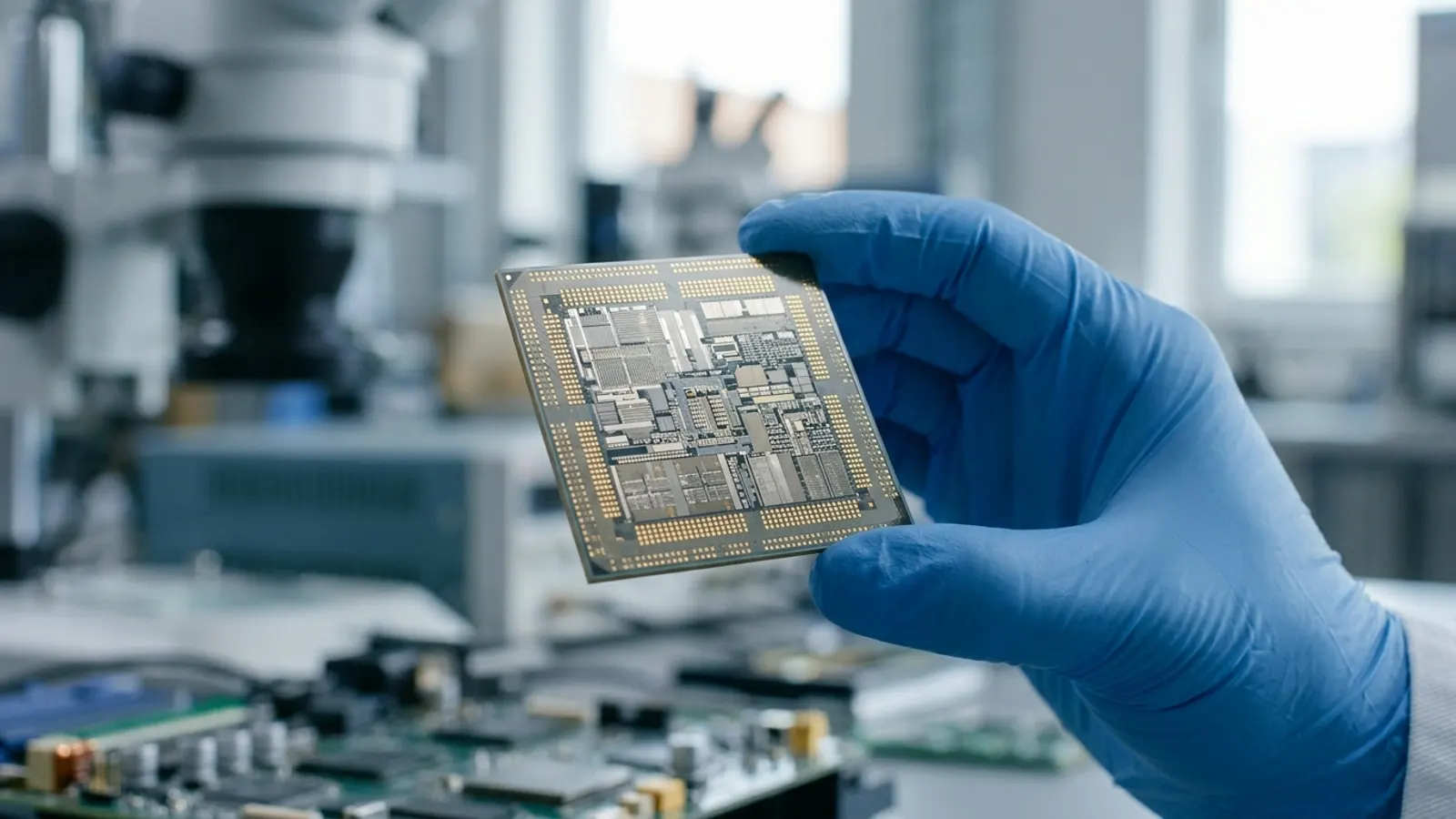
Shares of chip designer Arm Holdings plummeted on Thursday after the company's second-quarter earnings revealed a sharp deceleration in recurring royalty revenue. While overall quarterly revenue and adjusted profits topped expectations, stagnation in consumer smartphone chip shipments rattled investors who had bid the company up to an extreme valuation multiple. For everyday investors and consumers, this corporate selloff highlights the growing divide between corporate artificial intelligence (AI) investments and consumer hardware upgrades.
What is happening
Arm Holdings plc saw its stock fall sharply during intraday trading on Thursday, November 5, 2026. Arm shares plunged 12.45% (widely rounded to 12.5%) to reach $167.93 at 11:15 a.m. ET, falling from a previous closing price of $191.80 on Wednesday, November 4, according to market data from GuruFocus and TradingView. The pullback came after an extended run in which Arm had gained 75% year-to-date through the close of November 4, 2026, as tracked by Invezz and Tickeron.
| Metric | Q2 FY2027 Reported | Prior Consensus / Guidance | Prior-Year Comparison | Source |
|---|---|---|---|---|
| Total Revenue | $1.443 billion | $1.38 billion (Consensus) | Up 27% YoY | Arm Shareholder Letter / Investing.com |
| Royalty Revenue | $670 million | $705M to $720.8M (Estimates vary) | Up 8% YoY | Stock Titan / Invezz |
| Licensing Revenue | $773 million | $625.1M to $668M | Up 50% YoY | GuruFocus / Investing.com |
| Adjusted Diluted EPS | $0.52 | $0.47 to $0.48 | Up 33% YoY | MarketBeat / Benzinga |
| GAAP Net Income | $130 million | N/A | Down 45% YoY | Crypto Briefing |
The headline numbers for Arm’s fiscal second quarter, which ended September 30, 2026, initially looked robust. Total revenue climbed 27% year-over-year to $1.443 billion, beating the Wall Street consensus estimate of $1.38 billion compiled by LSEG and reported by Investing.com, as well as topping the company's prior guidance range midpoint of $1.38 billion ±$50 million cited by Stock Titan. Non-GAAP adjusted earnings per share reached $0.52, exceeding consensus estimates of $0.47 to $0.48 cited by MarketBeat and Benzinga.
However, GAAP net income fell 45% year-over-year to $130 million (with GAAP diluted earnings per share declining from $0.22 to $0.12) as research and development expansion and operating costs escalated, as detailed in Arm's Form 6-K filing. For the upcoming third fiscal quarter, Arm projected revenue of $1.54 billion ±$50 million, near the consensus estimate of $1.53 billion, alongside non-GAAP earnings per share guidance of $0.56 ±$0.04 against a $0.55 consensus, according to figures compiled by Seeking Alpha.
Why it is happening: Drivers behind Arm stock falling
The primary catalyst for the stock decline was not the top-line revenue beat, but the underlying composition of that revenue. Understanding this requires separating Arm's two primary revenue streams: upfront licensing fees and recurring per-unit royalties.
1. Slowing recurring royalties and consensus misses
Royalty revenue represents recurring payments collected every time an original equipment manufacturer (OEM) ships a chip incorporating Arm architecture inside a retail device. During the quarter, total royalty revenue rose 8% year-over-year to $670 million, marking its slowest pace of growth in eight quarters, as reported by Stock Titan.
Consensus trackers tracked a shortfall against analyst projections:
- Invezz and GuruFocus recorded a Wall Street consensus projection of $705 million.
- Moomoo Insights reported an expectation of $706 million.
- BigGo Finance and Investing.com cited an LSEG consensus figure of $720.8 million.
Because investors view recurring royalties as the cleanest gauge of real-world device demand, a miss in this segment raised immediate red flags. Readers learning how stock market indices work often see how heavy weighting in top tech names can quickly transmit such single-stock drops across broad index funds.
2. Smartphone stagnation and memory price spikes
Smartphones continue to account for the core volume of Arm's consumer royalty stream. On the November 4 earnings call, Arm CEO Rene Haas explained that mobile Edge AI royalties were "roughly flat YoY," as transcribed by The Motley Fool.
A primary culprit is the rising bill-of-materials (BOM) cost facing hardware manufacturers. Elevated pricing for dynamic random-access memory (DRAM) and NAND flash memory has raised production expenses for mobile device makers. In response, OEMs have constrained production runs, and consumer replacement cycles have slowed, as noted by GuruFocus.
3. Licensing revenue lumpiness vs. recurring growth
Upfront licensing and other revenue jumped 50% year-over-year to $773 million, making up approximately 54% of Arm's total revenue, according to GuruFocus. This beat analyst projections, which sat between $625.1 million and $668 million. Licensing deals—such as three new Arm Total Access (ATA) contracts and four Compute Subsystem (CSS) agreements—represent one-off design access purchases rather than guaranteed device shipments. Investors frequently discount licensing surges because contract timing can be uneven and difficult to replicate consistently quarter-over-quarter.
4. Cloud AI growth cannot yet bridge the volume gap
Data center momentum remained strong: Arm data center royalties doubled year-over-year. According to the Arm Shareholder Letter, Arm-based server market share across major hyperscalers (including AWS Graviton, Microsoft Cobalt, Google Axion, and NVIDIA Grace/Vera) exceeded 50% in 2025 (up from 15% in 2024) and is pacing toward more than 60% by calendar year-end 2026.
However, cloud server central processing unit (CPU) royalties still represent under 25% to 30% of Arm's total royalty income, as Arm CFO Jason Child pointed out on the earnings call. As a result, rapid growth in data centers could not fully compensate for sluggish consumer handset volumes. When high-flying tech firms experience such sector rotation, investors tracking chip stocks tumbling on earnings fears frequently see valuation contractions take place.
5. High valuation multiples and legal overhang
Arm entered the earnings release trading at a trailing price-to-earnings (P/E) multiple of 172.2x to 196.0x, according to data from GuruFocus and Google Finance. At an earnings multiple above 170x, meeting consensus forward guidance ($1.54 billion guided vs. $1.53 billion expected) left no cushion for slowing core royalties, as analyzed by Crypto Briefing.
Adding to investor caution is a mixed legal verdict delivered by a Delaware federal jury in October 2026 regarding Arm’s licensing dispute with Qualcomm over Nuvia architectures. While the jury found a partial breach, it awarded only nominal damages of $2, leaving future licensing structures with key partners ambiguous, according to BigGo Finance.
How it affects the economy
The pullback in Arm's stock and the underlying supply-chain dynamics have several broader economic implications:
- Goods disinflation and hardware inflation: Memory price pressures and advanced packaging costs create cost friction in consumer technology hardware, as noted by GuruFocus. This trend reinforces patterns of "sticky" goods prices monitored by central banks, where retail electronics prices fall at a noticeably slower pace than historical norms.
- Interest rate sensitivity: Equities trading at extreme multiples are especially sensitive to sovereign bond yields, as reported by Investing.com. With the Federal Reserve, the Bank of England, and the European Central Bank maintaining plateaued policy interest rates in late 2026 to curb services inflation, discount rates applied to long-term earnings compress valuations whenever near-term growth stumbles. Readers can examine how rising interest rates affect stocks, gold, savings, and loans to see how rate environments alter equity valuations.
- Capital expenditure concentration: Autumn economic outlooks published by the International Monetary Fund (IMF) and the Organisation for Economic Co-operation and Development (OECD) observed that the broader economic lift from AI hardware spending remains concentrated among fewer than ten mega-cap companies. Both institutions warned that broader economies remain exposed to asset repricing shocks if hardware monetization milestones fail to spread across consumer markets. Financial stability reports from the Bank of England and the Federal Reserve throughout 2025 and 2026 have likewise noted that high equity concentration in semiconductor architecture design firms poses transmission risks for household wealth.
- Capital flows and currencies: Arm is dual-headquartered in Cambridge, UK, but trades via American Depositary Receipts (ADRs) denominated in US dollars on the Nasdaq. The single-session wipeout of roughly $24 billion in market value led institutional funds to rotate capital out of dollar-denominated growth tech into defensive sovereign paper and commodities.
What it means for you
The ripple effects of Arm’s quarterly earnings report vary across regions, particularly regarding personal finances, technology purchases, and retirement accounts.
United States
- Retirement accounts: Arm is held within prominent exchange-traded funds (ETFs) such as the Invesco QQQ Trust, the iShares Semiconductor ETF (SOXX), and the VanEck Semiconductor ETF (SMH). A 12.5% intraday drop in an enterprise valued above $180 billion creates an immediate drag on tech-heavy 401(k) portfolios and retail target-date retirement funds.
- Retail consumer hardware: Rising component costs and adoption of the Armv9 architecture—which commands roughly double the royalty rate of the previous Armv8 design—mean manufacturers are passing along $30 to $80 per-unit price increases on mid- and high-tier smartphones, tablets, and AI PCs, as highlighted in the Arm Q2 Shareholder Call.
- Borrowing costs: Benchmark US Treasury yields remained stable following the release, leaving standard 30-year fixed mortgage rates unaffected by the tech selloff.
United Kingdom
- Pensions and ISA investments: Major UK institutional managers, including Baillie Gifford and Legal & General, along with majority owner SoftBank, hold sizable positions in Arm. British retail savers exposed to global equity funds inside workplace pension schemes or Individual Savings Accounts (ISAs) face portfolio headwinds from the decline. The event has also revived discussion over Arm's decision to list its shares in New York rather than London.
- Consumer electronics: UK shoppers purchasing updated devices face the same $30 to $80 per-unit hardware price increases passed along by global OEMs coping with expensive memory chips.
- Mortgage rates: Standard 2- to 5-year fixed home loans are tied to broader gilt yields and Bank of England monetary policy, meaning mortgage borrowing costs were unimpacted by Arm's individual corporate results.
Europe
- Investment funds: European retail investors holding global tech mutual funds or UCITS-compliant ETFs managed by institutions such as UBS encounter mild valuation pressure from Arm's decline.
- Device prices: Eurozone consumers purchasing AI-capable PCs and smartphones will also see manufacturers passing on the $30 to $80 per-unit cost increases across mid-range and premium electronics.
- Home financing: European mortgage rates remain dictated by benchmark European Central Bank rate targets and sovereign debt yields, experiencing no direct impact from semiconductor market turbulence.
How this could play out
Semiconductor market cycles and design adoption paths present multiple trajectories. Here are three distinct scenarios for how Arm's market standing could unfold.
Scenario 1: Smartphone stagnation persists through 2027
If dynamic random-access memory and flash memory costs remain elevated throughout calendar year 2027, global smartphone replacement cycles could remain flat. During the Q2 earnings conference call, BofA Securities analyst Vivek Arya questioned management regarding downside protection if smartphone volumes fail to rebound, as reported by Seeking Alpha.
Historically, when market saturation collides with component inflation, high-valuation design firms face compressed valuation multiples. For instance, between 2007 and 2010, Intel missed the transition toward low-power mobile architectures, ultimately enabling Arm to capture over 95% of smartphone application processors, as detailed in historical retrospectives from The Wall Street Journal. If mobile royalty volume remains sluggish, Arm's trailing P/E multiple could experience further downward pressure.
Scenario 2: Data center and custom AGI silicon offset mobile cycles
Under an alternative scenario, Arm's aggressive push into enterprise data centers successfully absorbs consumer electronics weakness. Harlan Sur of J.P. Morgan Chase & Co. reaffirmed an Overweight rating on Arm following the earnings report, though he lowered his price target from $255 to $245, according to Seeking Alpha and Invezz. Sur described the operational quarter as solid, noting licensing revenue milestones such as a $209 million SoftBank accelerator contract, while acknowledging investor anxiety around the ramp-up of the Arm AGI CPU scheduled for commercial shipments in fiscal Q4 2027.
Management has signaled potential custom silicon sales reaching up to $2 billion across fiscal years 2027 and 2028, according to Seeking Alpha. If server market share surpasses the guided 60% mark among major cloud providers, enterprise royalties could become Arm's primary growth driver.
Scenario 3: Commercial ramp delays and valuation reset
A third scenario involves execution delays. Raymond James analyst Simon Leopold urged caution regarding custom CPU commitments, writing that while management projects significant revenue, market participants need to see "more tangible trends" before factoring those projections into valuation models, as cited on Investing.com.
History demonstrates the risks of elevated valuations. In February 2024, Arm shares surged over 60% in a single trading session on early AI enthusiasm, driving multiples past 100x forward earnings, as reported by Reuters and Bloomberg. During mid-2024, subsequent quarterly updates that failed to vastly exceed expectations resulted in single-day pullbacks of 8% to 10%. Furthermore, multi-year patent disputes, such as Qualcomm's historical licensing battles with device makers and regulators between 2017 and 2019, show how per-device royalty structures face friction when OEMs challenge licensing fees during periods of margin compression.
What you can do now
Sudden market declines in high-profile semiconductor companies can be disorienting for everyday investors. Practical, steady steps can help manage market turbulence:
- Audit portfolio concentration: Review your holdings across individual stocks, mutual funds, and technology ETFs. If a single sector or stock accounts for an outsized portion of your portfolio, consider whether your overall allocation aligns with your risk tolerance.
- Maintain sound budgeting practices: If you are shopping for a new smartphone, tablet, or laptop, account for potential $30 to $80 per-unit retail price increases caused by elevated component and architectural costs.
- Focus on broad diversification: Avoid attempting to time volatile semiconductor swings. A diversified portfolio holding a mix of global equities, fixed-income assets, and cash buffers helps mitigate single-stock drawdowns. Reviewing guides on how to read stock charts can also provide technical context on market volatility.
- Avoid reactionary trades: Large intraday selloffs can tempt investors to sell at the bottom or make speculative bets. Sticking to a disciplined, long-term plan is typically more effective than reacting to short-term headlines.
- Formulate targeted questions for financial advisers: When consulting a qualified financial professional, ask:
- How exposed is my current retirement plan to semiconductor and mega-cap tech concentration?
- Does my asset allocation account for elevated equity multiples in a plateaued interest rate environment?
- How do current component costs and device upgrade cycles affect my household tech spending budget?
FAQ
Why did Arm stock drop if it beat revenue estimates?
Arm beat overall revenue estimates by posting $1.443 billion against a $1.38 billion consensus, but the composition of that revenue concerned investors. Upfront licensing surged 50%, while recurring per-unit royalties grew only 8% to $670 million—missing consensus estimates that reached as high as $720.8 million. Because Arm traded at an earnings multiple above 170x, the royalty slowdown triggered a valuation reset.
What caused the slowdown in Arm's mobile royalties?
Mobile Edge AI royalties remained roughly flat year-over-year. High prices for memory components (DRAM and NAND flash) raised bill-of-materials costs for smartphone makers, causing them to constrain device production and leading consumers to delay device upgrades.
How quickly is Arm growing in data centers?
Arm's data center royalties doubled year-over-year in Q2 FY2027. Arm-based processors held more than 50% market share at major cloud hyperscalers in 2025 and are projected to exceed 60% by the end of calendar year 2026. However, data center royalties still make up less than 25% to 30% of Arm's total royalty pool.
How will this earnings report affect consumer electronics prices?
Hardware makers are navigating higher memory component costs and the Armv9 architecture licensing premium, which carries roughly double the royalty rate of the Armv8 design. Consequently, OEMs are passing along $30 to $80 per-unit price increases to retail buyers of mid- and high-tier smartphones, tablets, and AI PCs.
Sources
- GuruFocus: Arm Stocks Fall 12.45% Despite Doubling Data Center Royalties
- TradingView: Arm Stock Performance and Price Action
- Stock Titan: Arm Holdings Form 6-K SEC Filing
- Investing.com: Arm Stock Slips After Hours Despite Results Beat
- Invezz: Arm Stock Falls as Weak Smartphone Royalties Offset Growth
- Tickeron: Arm Reports 27% Revenue Growth in Fiscal Q2
- GuruFocus: Arm Stock Falls After Smartphone Memory Pricing Hits Royalties
- Stock Titan: Arm Earnings Q2 Fiscal 2027 Analysis
- BigGo Finance: Arm Q2 FY2027 Financial Release
- The Motley Fool: Arm Holdings Q2 2027 Earnings Call Transcript
- Seeking Alpha: Arm Holdings Slips Even as Q2 Results Top Estimates
- MarketBeat: Arm Holdings Q2 Earnings Report
- Crypto Briefing: Arm Holdings Record Revenue Stock Falls
- Investing.com: Why Is Arm Stock Sliding Today?
- Google Finance: Arm Holdings plc (ARM) Quote
This article is for informational purposes only and is not financial advice. Markets move quickly; check live prices before making decisions.