Explainer - 12 min read
Why Are Oil Prices Falling? What It Means for You
Oil prices are falling as surging U.S. crude inventories and recovering Middle East exports outweigh shipping disruption risks. Here is what it means for you.
FinStackX Editorial Team · Editor: Alex Webster ·
Crude oil benchmarks are retreating as an unexpected surge in U.S. fuel stockpiles and recovering Middle East output collide with sluggish global demand. Although crude remains up significantly year-on-year, this pullback is easing cost pressures across energy markets while complicating central bank interest rate decisions. For households in the United States, the United Kingdom, and Europe, understanding why are oil prices falling provides crucial insight into fuel bills, mortgage rates, and broader living costs.
What is happening
Global benchmark crude contracts dropped sharply on Wednesday, November 18, 2026. In morning European trade, front-month January 2027 Brent crude futures fell 1.1% (down $1.00 to $1.07) to trade around $92.14 to $92.15 per barrel, according to CNBC. The contract touched an intraday low of $91.00 before fluctuating between $91.99 and $93.10 across afternoon sessions, as reported by Reuters. Brent settled Tuesday at $93.14 per barrel (or $93.02 according to Investing.com data).
Across the Atlantic, West Texas Intermediate (WTI) futures for December 2026 delivery slipped 1.78% to 2.0% ($1.53 to $1.67) to $84.34–$84.48 per barrel, hitting an intraday low of $83.58—its lowest level since late August 2026. This divergence widened the prompt Brent/WTI spread beyond $7.50 to $8.00 per barrel, its widest gap in two weeks, according to LSEG Data & Analytics.
| Metric / Benchmark | Recent Level | Prior Benchmark / Context | Source |
|---|---|---|---|
| Brent Crude (Jan 2027) | $92.14–$92.15 / bbl | Down ~20% in Nov 2026 from early-Oct peak ($136.00) | CNBC / Reuters |
| WTI Crude (Dec 2026) | $84.34–$84.48 / bbl | Low of $83.58 (lowest since late August 2026) | CNBC / Reuters |
| API U.S. Crude Stocks | +5.28M barrels | Expected: -0.5M barrel draw (5.78M barrel surprise) | American Petroleum Institute |
| API U.S. Gasoline Stocks | +5.12M barrels | Build reflects softening domestic product demand | Reuters |
| U.S. Crude Production | 14.013M bpd | Record high for week ending November 6, 2026 | EIA |
| U.S. Strategic Reserve | 276.4M barrels | Lowest operational level since August 1982 | U.S. DOE |
Even with Brent down roughly 20% month-to-date from its early-October Dated Brent peak of $136.00, it remains up 40% to 50% year-on-year, reflecting an underlying energy complex caught between physical accumulation and structural risk.
Why are oil prices falling?
The downward momentum in oil markets stems from a confluence of building commercial stockpiles, blocked export lanes, rising regional production, and shifting global consumption trends.
Bearish U.S. inventory accumulation
The primary catalyst for the midweek decline was the weekly statistical release from the American Petroleum Institute (API). For the week ended November 13, 2026, U.S. commercial crude inventories expanded by 5.28 million barrels, according to data reported by Reuters. This stood in stark contrast to expectations in a Reuters consensus poll projecting a 500,000-barrel decline, creating a 5.78-million-barrel bearish shock.
Compounding the surplus, API reported that U.S. gasoline stocks surged by 5.12 million barrels, while distillate inventories (diesel and heating oil) rose by 351,000 barrels. This build pointed toward seasonal refinery run cuts and softer domestic product absorption heading into late Q4. Official data from the U.S. Energy Information Administration (EIA) for the prior week (ended November 6) showed commercial crude inventories at 414.4 million barrels—4.0% to 4.4% below their five-year seasonal average, but continuing to build on back-to-back weekly increases.
Shut export arbitrage and freight bottlenecks
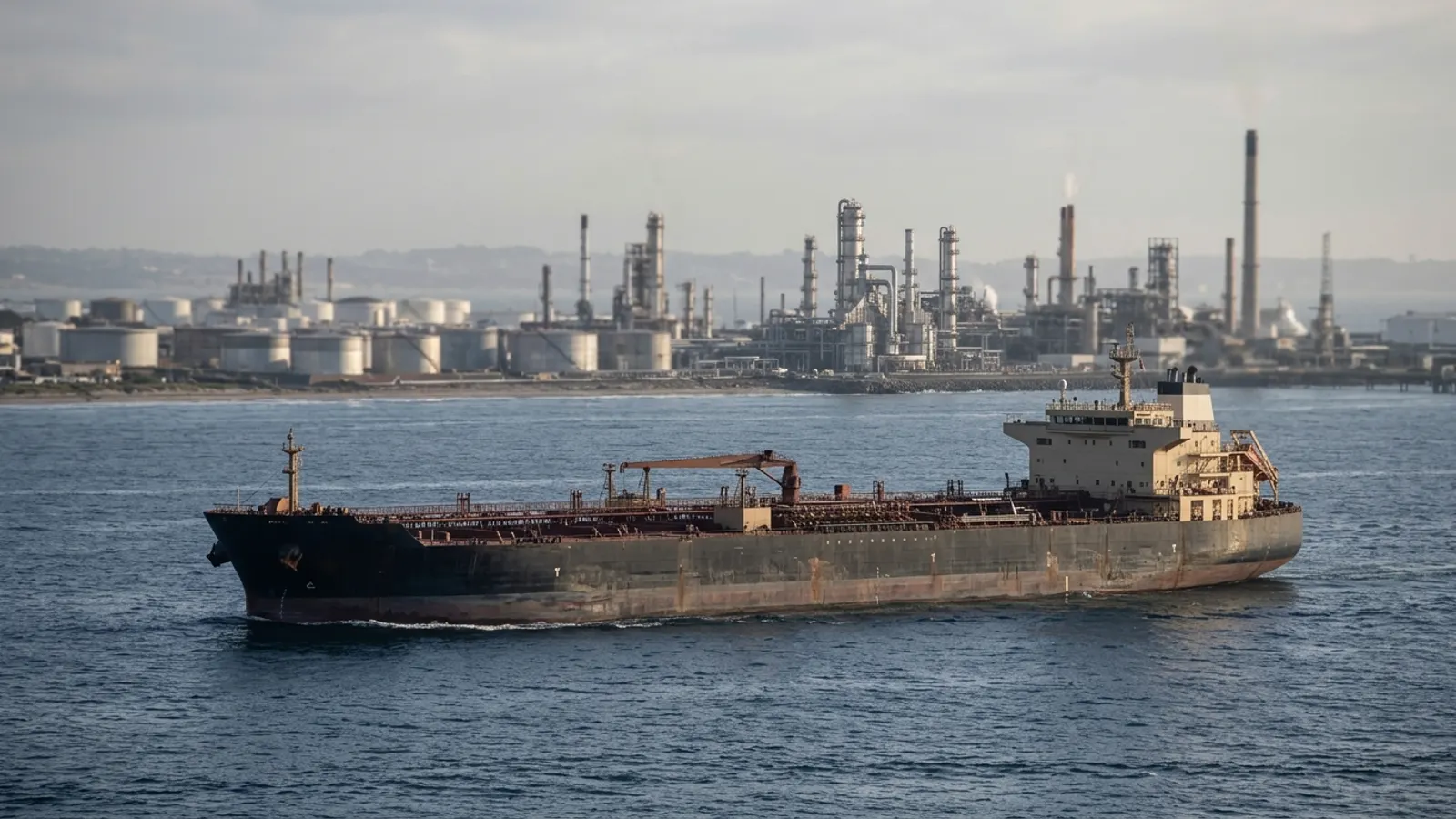
U.S. crude has increasingly pooled along the Gulf Coast due to prohibitive long-haul shipping dynamics. Elevated tanker freight rates and steep maritime insurance surcharges closed the transatlantic and transpacific arbitrage windows (the price differential needed to profitably transport physical barrels overseas).
As June Goh, Senior Analyst at Sparta Commodities, explained to Reuters: "WTI arbitrage trades have been shut to Asia and North West Europe, thus WTI correcting more than Brent is the expected price movement to allow the arbitrage window to open again."
Rebounding Middle East volumes vs. shipping chokepoints
Physical scarcity has eased as Middle Eastern supply lines partially normalize. Gulf crude exports (excluding Oman) recovered to 15.0 million barrels per day (bpd) in October 2026, reaching 82% of pre-war capacity, according to the International Energy Agency (IEA).
Yet, the retreat in prices remains bounded by ongoing conflict. On November 17, an ADNOC L&S vessel was struck in the Strait of Hormuz, leaving one crew member missing and 11 injured, while the UK Maritime Trade Operations (UKMTO) recorded seven maritime incidents between November 10 and November 18. Analysts at LSEG highlighted that "normalization of flows through Hormuz is still not possible under current conditions," setting a resilient geopolitical floor beneath Brent.
Cooling Asian demand and a strong U.S. dollar
Global consumption signals are softening. Chinese refinery throughput fell 8.1% year-on-year in October 2026 and 2.0% month-on-month, according to China's National Bureau of Statistics and the IEA. At the same time, the U.S. Dollar Index (DXY) rose to 103.79 on November 18 (+0.29% on the day and +1.77% over 30 days), according to Trading Economics. A stronger greenback increases local-currency oil import costs for non-dollar economies, weighing on international purchases.
How it affects the economy
Energy prices act as a master variable across macroeconomics, influencing central bank policies, production costs, and overall market stability.
Inflation pass-through to core prices
While falling headline crude offers immediate optics of disinflation, central banks remain concerned about delayed pass-through. Federal Reserve research released on November 13, 2026 (via ITR Economics), found that a sustained 10% move in crude prices lifts core Personal Consumption Expenditures (PCE) and Consumer Price Index (CPI) readings by 0.35 percentage points over a three-year horizon. This is up sharply from a 0.05-percentage-point pass-through rate prior to 2020, driven by higher intermediate packaging, freight, and industrial processing expenses.
Monetary policy and interest rate paths
- United States: The Federal Reserve held its benchmark target rate at 3.75%–4.00% on October 28, 2026. Investors reviewing the FOMC minutes are assessing whether crude stabilizing near $90/bbl eliminates the need for an additional 25-basis-point rate hike in December.
- United Kingdom: The Bank of England raised its Bank Rate by 25 basis points to 4.00% on November 5, 2026—its first increase in over three years. BoE Governor Andrew Bailey stated that resolving geopolitical tensions and sustaining lower energy prices could limit the need for further monetary tightening, though Deputy Governor Clare Lombardelli warned on November 10 that if energy costs fail to retreat meaningfully, another December rate hike remains on the table, as reported by 2News.
- Europe: At COP31, European Central Bank Governing Council member Olaf Sleijpen emphasized that mitigating fossil fuel volatility is crucial to maintaining medium-term price stability, according to Green Central Banking. Michael Bolliger at UBS Global Wealth Management noted that lower crude could prevent an overtightening cycle across the Eurozone heading into early 2027.
Equity markets and corporate margins
Energy cost fluctuations create distinct winners and losers. Capital-intensive manufacturers and transportation firms benefit when fuel surcharges drop, while energy producers face compressing profit margins. Investors tracking corporate earnings season can evaluate these margin impacts using how to read earnings reports, especially as broader sentiment mirrors recent movements across Asia and Europe markets.
What it means for you
The retreat from early-October price peaks has concrete implications for household balance sheets across regions.
United States
- Mortgage borrowing costs: U.S. 30-year fixed mortgage rates averaged 7.37% in early November 2026, according to the Mortgage Bankers Association (MBA). Easing crude prices helps relieve upward pressure on sovereign debt, influencing why the 10-year Treasury yield has been rising and potentially preventing home financing rates from breaking above 7.50%.
- Retail fuel and heating: While gasoline price moderation has bolstered consumer mood following the November 3 midterm elections—a dynamic explored in why stocks surged after the midterms—heating expenses remain high. Average residential heating oil stood at $5.915 per gallon in the week of November 9, 2026, according to the EIA.
- Pensions and savings: Elevated policy rates keep cash deposit yields around 3.5% to 4.5% across major commercial banks. For retirement plans like 401(k) accounts, falling energy overhead helps cyclical consumer stocks, while defined benefit schemes continue to register healthier liability funding ratios due to higher sovereign yields.
United Kingdom
- Mortgage refinancing: Following the Bank of England's rate hike to 4.00%, an estimated 1.5 million UK homeowners refinancing in late 2026 face interest rates between 4.5% and 5.5%, severely squeezing household discretionary income.
- Inflation and utility bills: The UK Office for National Statistics (ONS) projected that motor fuel and utility components would keep headline CPI around 3.6% through October and November, reported Bloomberg.
- Savings and retirement: UK cash savings accounts offer returns between 3.5% and 4.5% in line with the Bank Rate. Self-Invested Personal Pensions (SIPPs) exposed to domestic retail and industrial equities benefit from stabilized energy overhead, while defined benefit pension deficits have narrowed.
Europe
- Industrial strain and floating debt: Euribor-linked floating mortgage holders across Southern Europe face elevated debt-servicing costs, keeping consumer sentiment subdued.
- Diesel and distribution premiums: The Atlantic Basin middle distillate crack spread (the refining margin between crude and diesel) averaged ~$80 per barrel in October 2026, far above the $22 per barrel margin for gasoline. With European retail diesel hovering near $180 per barrel (roughly 77% above pre-war benchmarks), freight, shipping, and grocery distribution costs remain exceptionally stiff across the continent, according to the IEA.
How this could play out
Energy analysts view the market as finely balanced between immediate geopolitical disruption and looming structural oversupply. These are scenarios based on current data, not guarantees.
                  ┌───────────────────────────────────────────────┐
                  │   Crude Oil Market Drivers (Late 2026)        │
                  └───────────────────────┬───────────────────────┘
                                          │
            ┌─────────────────────────────┴─────────────────────────────┐
            ▼                                                           ▼
┌───────────────────────────────────────┐   ┌───────────────────────────────────────┐
│     Downside Pressure (Surplus)       │   │     Upside Pressure (Supply Risk)     │
├───────────────────────────────────────┤   ├───────────────────────────────────────┤
│ • Americas output: +1.6M bpd in 2026  │   │ • Hormuz maritime attacks (UKMTO)     │
│ • U.S. crude build: +5.28M barrels    │   │ • Shut transit routes & tanker costs  │
│ • Weak China refinery run (-8.1% YoY) │   │ • Depleted U.S. SPR (276.4M barrels)  │
│ • IEA Q4 2026 surplus: 1.7M bpd       │   │ • Core inflation pass-through to CPI  │
└───────────────────────────────────────┘   └───────────────────────────────────────┘
Scenario 1: A structural surplus pushes prices lower
Under this scenario, physical supply outstrips demand as anticipated by institutional researchers. The IEA projects that global oil balances will return to an oversupply of 1.7 million bpd in Q4 2026, scaling back total 2026 demand to 102.3 million bpd (a 2.7-million-bpd annual contraction) before expanding by 2.0 million bpd in 2027, according to its November 2026 Oil Market Report. Non-OPEC output from the "Americas Quintet" (U.S., Canada, Brazil, Argentina, and Guyana) is projected to add 1.6 million bpd in 2026 and 1.1 million bpd in 2027.
Commodities research from Goldman Sachs models an oil surplus of 2.0 million bpd in 2027, forecasting Brent will average $88.00 per barrel next year before declining to $78.00 by December 2027. This outcome assumes the successful bypassing of Strait of Hormuz chokepoints via overland Saudi and UAE pipelines, the reopening of Red Sea shipping routes, and an ongoing structural demand drag of 400,000 bpd from China due to rapid electric vehicle (EV) adoption.
Historically, this aligns with the July 2008 cycle, when Brent surged to $147.50 per barrel before high prices destroyed demand, causing crude to drop below $40 by early 2009 as commercial inventories surged.
Scenario 2: Chokepoint disruptions reignite price spikes
If military escalation shuts Persian Gulf transit lanes or knocks out regional pipeline links, physical scarcity could overwhelm commercial builds. Vandana Hari, founder of Vanda Insights, observed via Reuters that crude remains "wedged between a persistent geopolitical risk premium from tanker attacks and escalating tit-for-tat US-Iran strikes, and an increasingly bearish sentiment from a chorus of analysts forecasting a sizeable market surplus."
Should maritime routes face deeper blockages, the 15.0 million bpd of recovering Gulf exports could be choked off again. With the U.S. Strategic Petroleum Reserve at 276.4 million barrels—its lowest level since August 1982—governments have limited capacity to counter sudden supply deficits. History mirrors this in the 1979 Iranian Revolution and 1980 Iran-Iraq outbreak, where a 5.6-million-bpd supply contraction sparked prolonged stagflation and delayed consumer relief.
What you can do now
With energy markets fluctuating, personal finance strategies should prioritize adaptability over market timing:
- Review energy consumption: While crude has retreated, refining constraints keep diesel and heating oil high. Reassessing household heating efficiency, insulating properties, and checking fuel supplier rates can protect budgets.
- Maintain cash buffers: Retail banks across the US, UK, and Europe continue to offer competitive cash deposit rates (3.5%–4.5%). Maintaining an emergency fund covering three to six months of expenses helps offset volatile utility and mortgage payments.
- Budget for debt resets: Homeowners in the UK and Europe facing floating rates or impending fixed-rate refinancing should run stress-test calculations at interest rates between 4.5% and 5.5%.
- Keep long-term portfolios diversified: Avoid making drastic portfolio shifts based on short-term commodity price movements. Broad exposure across sectors hedges against both energy inflation and cyclical slowdowns.
- Consult regulated professionals: If you are uncertain about retirement allocations or debt restructuring, schedule a review with an accredited financial adviser to evaluate your specific situation.
FAQ
Will oil prices go back up?
Price direction depends on whether maritime security or commercial oversupply dominates. Analysts at Goldman Sachs and the IEA forecast market surpluses ranging from 1.7 to 2.0 million barrels per day through 2027, which could pressure Brent toward $78 to $88. However, further military conflict in the Strait of Hormuz could quickly restore a steep risk premium.
Why is diesel more expensive than gasoline?
Refining capacity has struggled to keep pace with demand for middle distillates. In October 2026, Atlantic Basin middle distillate refining margins reached ~$80 per barrel compared to $22 per barrel for gasoline. This has kept European retail diesel near $180 per barrel, sustaining elevated shipping and transport costs.
How do lower oil prices affect interest rate decisions?
A drop in crude helps reduce headline inflation figures. However, because sustained oil price increases filter into freight, manufacturing, and food costs over several years, central banks like the Fed, the BoE, and the ECB require consistent evidence that price drops are durable before cutting policy rates.
What is the Brent/WTI spread and why does it matter?
The Brent/WTI spread is the price difference between international benchmark Brent and U.S. benchmark West Texas Intermediate. A widening spread (recently exceeding $7.50 to $8.00 per barrel) indicates that oil is accumulating within the United States due to high export shipping costs, depressing domestic prices relative to international markets.
Sources
- Euronext Financial News: Oil Prices Fall as Higher U.S. Crude Stocks Temper Supply Risks
- Invezz: Brent Slips as API Shows 5.28 Million Barrel U.S. Crude Build
- Hindustan Times: Oil Prices Fall 2% on U.S. Crude Inventories Rise
- FinanceFeeds: Brent Crude Oil Price Analysis and Fed Minutes Preview
- Crux Investor: Tanker Costs Widen WTI's Discount to Brent
- International Energy Agency (IEA): Oil Market Report November 2026
- CEENERGYNEWS: IEA Oil Market Report Q4 2026
- Barchart: Crude Prices Supported by Geopolitical Concerns and Inventory Data
- Crypto Briefing: Goldman Sachs Warns of 2027 Oil Market Surplus
- Trading Economics: United States Currency and DXY Index
- 2News: Bank of England Welcomes Energy Price Trends Following Bank Rate Hike
- Green Central Banking: Cutting Fossil Fuels Vital for Inflation Control, Says ECB's Sleijpen
- UBS Global Wealth Management: Central Bank Rate Dynamics and Energy Trends
This article is for informational purposes only and is not financial advice. Markets move quickly; check live prices before making decisions.